
Key takeaways
- DISC measures observable behaviour, MBTI measures cognitive preference, and the Enneagram measures core motivation. They are not competitors; they answer different questions.
- For communication-style alignment in a large group, DISC is fast and cheap. For understanding how people take in information and decide, MBTI is useful. For changing how a senior leader actually leads, the Enneagram reaches the level where change happens.
- The most expensive mistake in L&D is buying a behaviour tool for a motivation problem — a leader who has done DISC three times and still has the same friction with their team.
- Use the 'worst day' test: only the Enneagram describes how a leader behaves under stress, and the stressed leader is the one the team actually works for.
- A practical rule: DISC for the whole company, MBTI for team communication, Enneagram for the leadership team and anyone being developed for the next level.
The Enneagram, MBTI and DISC are the three assessments most often put in front of leaders, and they measure three different things: DISC measures observable behaviour, MBTI measures cognitive preference, and the Enneagram measures core motivation. None is "the best". Each is the best at its own job — and most of the disappointment HR feels with personality tools comes from using a tool built for one job to do another.
If you are an HR or L&D leader choosing a diagnostic for a leadership programme, this guide will help you decide quickly. If you are a leader who has done all three and is still wondering why the same friction keeps appearing with your team, it will explain why.
What each tool actually measures
The clearest way to compare them is by the layer of the person each one describes.
| DISC | MBTI | Enneagram | |
|---|---|---|---|
| Measures | Observable behaviour and communication style | Cognitive preferences — how you take in information and decide | Core motivation — what you want, what you fear, where your attention goes |
| Number of types | 4 styles (D, I, S, C) and blends | 16 types from 4 dichotomies | 9 types, with wings and stress/growth movements |
| Answers the question | "How does this person act?" | "How does this person think and prefer to work?" | "Why does this person act this way — and what happens under stress?" |
| Best for | Sales teams, customer-facing roles, quick communication alignment in large groups | Team-building, understanding working-style differences, career reflection | Leadership development, executive coaching, leadership-team dynamics, conflict |
| Weakest at | Explaining why behaviour changes; depth | Stress behaviour; motivation; it is explicitly not for selection | Speed and scale in large groups; requires facilitation to land well |
| Time to debrief | Short — an hour | Half a day | A day or more; the value is in the facilitated conversation |
| Typical use in Asia | Company-wide, often in onboarding | Team workshops, graduate programmes | Senior leadership teams, founder coaching, succession development |
DISC: the behaviour layer
DISC is the right tool when you need a large group to quickly understand and adapt to each other's communication styles. It is simple, fast to debrief, and easy to remember — which is exactly why it spreads so well through sales organisations and customer-facing teams. A manager who knows their report is a "high S" will slow down and give more context; that is a real improvement, cheaply bought.
Its limit is built into its strength. DISC describes the surface. Two leaders can both profile as "high D" and be running on completely different fuel — one driven by a need for results and recognition, the other by a refusal to be controlled. Same behaviour, different motivation, different coaching. DISC cannot see the difference, and so a leader coached on DISC alone often gets advice that fits their profile and misses their pattern.
MBTI: the preference layer
MBTI is the right tool when you want people to understand that their colleagues genuinely take in information and make decisions differently — not wrongly. Its four dichotomies give a team a respectful vocabulary for those differences, and its sixteen types are familiar enough that most professionals already know theirs.
Two limits matter for leadership work. First, MBTI is deliberately non-evaluative: every type is presented as equally fine, which is kind but means it says almost nothing about blind spots or behaviour under stress. Second, the Myers-Briggs Company itself advises against using the instrument for hiring or promotion decisions, which tells you what it was built for — self-understanding, not performance. For a leadership programme whose goal is to change how someone leads, that is a significant gap.
Enneagram: the motivation layer
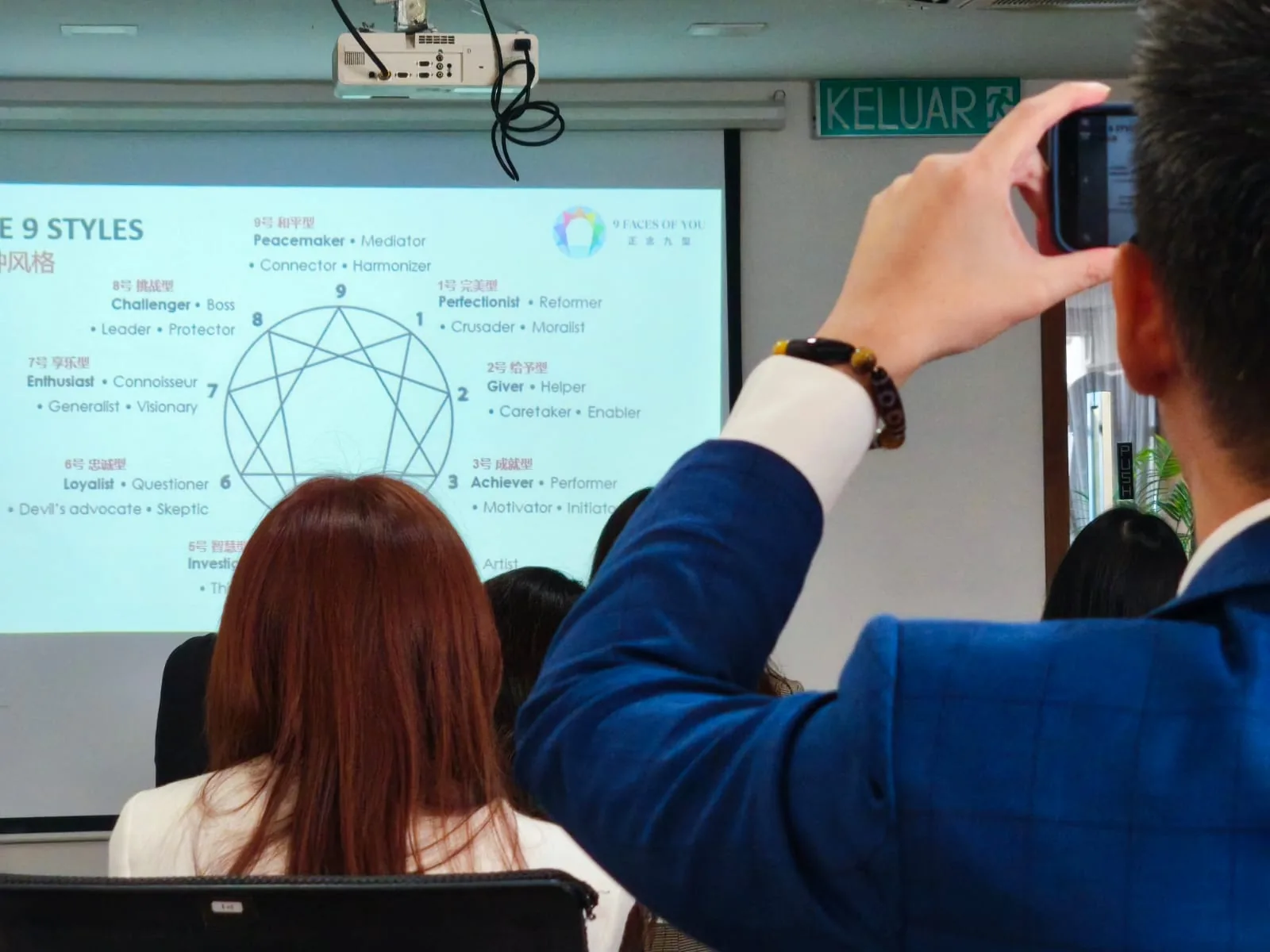
The Enneagram is the right tool when the goal is to change how a senior leader actually leads, because it is the only one of the three that reaches the layer where change happens. It describes nine core motivations — nine different things a person is fundamentally seeking and avoiding — and, crucially, how each type predictably behaves when it is under pressure. The Type 8 who becomes intimidating, the Type 9 who cannot decide, the Type 3 who burns out the team: these are stress patterns, and no behaviour or preference tool describes them.
"Success in the knowledge economy comes to those who know themselves — their strengths, their values, and how they best perform."
Peter F. Drucker · Managing Oneself, Harvard Business ReviewThe Enneagram's limit is also real: it does not scale as cheaply. You can hand a hundred people a DISC report and get value. Hand a hundred people an Enneagram result without facilitation and you will get a hundred people arguing about their type. It rewards depth — a skilled facilitator, a small group, time — which is why we use it with leadership teams rather than entire workforces, and why our Business Enneagram Leadership programme is a two-day intensive for a small class rather than a half-day for a hall.
The cost of choosing wrong
The most expensive mistake in leadership development is buying a behaviour tool for a motivation problem. It looks like this: a capable general manager has been through DISC twice and MBTI once. Each time, the report was accurate and the workshop was pleasant. Each time, the same complaint returned within a quarter — the team feels pushed, or unheard, or afraid to bring bad news. The GM concludes that the team is the problem. HR concludes that leadership training does not work.
Neither is true. The tools simply never reached the level where the pattern lives. Behaviour is downstream of motivation, and a leader who changes behaviour without understanding motivation will revert under pressure every time — because pressure is precisely when motivation takes over. This is what we mean when we say most leadership programmes change behaviour, and FutureX changes the leader — through self-awareness first.
A simple decision guide for HR and L&D
Match the tool to the outcome you are buying, not to the tool you know best.
- "We need the whole company to communicate better." Use DISC. It is fast, scalable and good enough. Do not expect it to develop your leaders.
- "We need a team to appreciate their working-style differences." Use MBTI or DISC in a facilitated team session. Either works; MBTI goes slightly deeper.
- "We need our leadership team to trust each other and stop avoiding the real conversations." Use the Enneagram, facilitated, over at least a day. This is a motivation and trust problem, and only a motivation tool reaches it. See how to use the Enneagram with your leadership team.
- "We are developing a senior leader for the next level, or coaching a founder." Use the Enneagram inside an executive-coaching engagement. What got them here is exactly what the Enneagram will show them — and what it will cost them next.
- "We have used DISC for years and it has plateaued." Keep DISC for the workforce; add the Enneagram for the leadership team. They complement each other well — DISC gives the shared vocabulary, the Enneagram explains why two "high Ds" behave so differently under stress.
What about validity?
All three are typologies, not trait measures like the Big Five, and all three rely on self-report — so the honest position is that none is a laboratory instrument, and the practical question is which one surfaces something a leader can act on. Published research on Enneagram inventories reports moderate reliability and mixed validity; MBTI has faced similar academic criticism for decades; DISC has the least independent research of the three. What we can say from more than a hundred workshops with leaders across Malaysia, Singapore and Greater China is that the Enneagram produces the most frequent moment of uncomfortable recognition — "that is exactly what I do" — and that moment is what leadership development is made of.
A note on culture
In Asian organisations, where hierarchy often keeps the most important feedback unspoken, a shared type language does something no tool report can: it makes the truth sayable without loss of face. "That's the Eight in you" is hearable in a way that "you're intimidating the team" is not. Any of the three tools can provide a vocabulary; in our experience only the Enneagram's vocabulary reaches the patterns that actually create the silence.
The bottom line
Use DISC for breadth, MBTI for team appreciation, and the Enneagram for the leaders you are serious about developing. If you are choosing one tool for a leadership team or an executive-coaching programme, choose the one that explains behaviour rather than describes it. For Malaysian companies, the Business Enneagram Leadership programme is HRD Corp claimable under SBL-Khas — see the 2026 claimable programmes — and every FutureX programme can be delivered in-house for an intact leadership team, in English or Mandarin.
Frequently asked questions
What is the main difference between the Enneagram, MBTI and DISC?
They measure different layers of a person. DISC describes observable behavioural style (Dominance, Influence, Steadiness, Conscientiousness). MBTI describes cognitive preferences across four dichotomies (for example Introversion–Extraversion, Thinking–Feeling). The Enneagram describes nine core motivations — the underlying desire, fear and habit of attention that drive behaviour, including how a person changes under stress.
Which is best for leadership development — Enneagram, MBTI or DISC?
For developing senior leaders, the Enneagram is usually the strongest choice because it reaches motivation, which is where blind spots and stress patterns live. DISC and MBTI are better suited to communication-style alignment across large groups. Many organisations use DISC company-wide and the Enneagram for the leadership team.
Can we use the Enneagram and DISC together?
Yes, and it often works well. DISC gives a quick shared vocabulary for how people prefer to communicate; the Enneagram explains why two people with the same DISC style behave very differently under pressure. Use DISC for breadth and the Enneagram for depth.
Is the Enneagram more accurate than MBTI?
Accuracy is the wrong frame — both are typologies rather than trait measures, and both rely on self-report. The practical question is which tool surfaces something a leader can act on. In our experience, leaders find the Enneagram's descriptions of motivation and stress behaviour more actionable than MBTI's cognitive preferences, because they explain the friction the leader is already experiencing.
Can personality assessments be used for hiring?
DISC and MBTI are widely used in hiring, though the Myers-Briggs Company itself advises against using MBTI for selection. We strongly recommend against using the Enneagram as a hiring filter: it describes motivation, not capability, and every type can succeed in every role. Use it for development, not selection.
Is Enneagram leadership training HRD Corp claimable in Malaysia?
Yes. FutureX Leader's Business Enneagram Leadership programme is HRD Corp approved (TP No. 10001712614) and claimable under SBL-Khas, both as a public cohort and delivered in-house for a leadership team.