
Key takeaways
- Successions in Malaysian family businesses stall on three relationships: founder and successor, the siblings or cousins who have to share, and the non-family managers who decide whether to stay. Plan those, and the legal and tax work falls into place.
- The founder and the successor are almost always different types of leader. That is not the problem. The problem is that neither has ever said out loud how they decide, how they give feedback and what they are afraid of.
- A handover is a twelve-month job with a calendar, not an announcement at Chinese New Year. The successor needs real authority over one whole area first, with the founder visibly staying out of it.
- The successor's leadership development is HRD Corp (HRDF) claimable when they are on the Malaysian company's payroll, so the programme that prepares them costs the family nothing upfront.
本文有中文版:马来西亚家族企业传承与接班 →
A family business in Malaysia survives succession when three relationships are planned as carefully as the shareholding: the founder and the successor, the siblings or cousins who will have to share, and the non-family managers who decide whether to stay for the next generation. Lawyers and accountants handle the shares and the trust. Nobody handles the relationships, which is why so many handovers that look complete on paper fall apart in the second year. This guide is about those relationships, drawn from our work with founders and successors across Malaysia and Greater China, in English and Mandarin.
The saying in Chinese families is 富不过三代, wealth does not survive three generations. It is repeated as fate. In our experience it is closer to a description of what happens when a family treats succession as a legal event rather than a leadership transition.
Why successions stall in Malaysian family businesses
Successions stall because the founder, the successor and the managers each have a different idea of what has been decided, and the culture of the family and the country keeps all three from saying so. A Malaysian family business, especially a Chinese-Malaysian one, runs on hierarchy, face and loyalty. Those are its strengths. They are also exactly the forces that stop a daughter from telling her father his way of deciding is now the bottleneck, and stop a twenty-year GM from telling anyone he will leave if the son takes over.
Three patterns come up again and again:
- The announced handover that never happens. The successor has the title. The founder still takes the calls, overrides the decisions and signs the cheques. The managers go to whoever will say yes.
- The siblings who were never asked. One child was told they would lead. The others found out. The business now has two or three centres of power and a family dinner nobody looks forward to.
- The quiet exit of the people who actually run things. Senior managers who grew up with the founder do not resign loudly. They stop volunteering, then they go to a competitor "for a better opportunity", and the successor inherits a company that has lost its memory.
Stephen Covey's advice to begin with the end in mind applies with unusual force. The end in a succession is not the day the shares transfer. It is the day the founder can be away for a month and nothing waits for him.
The founder and the successor are different leaders, and nobody has said so
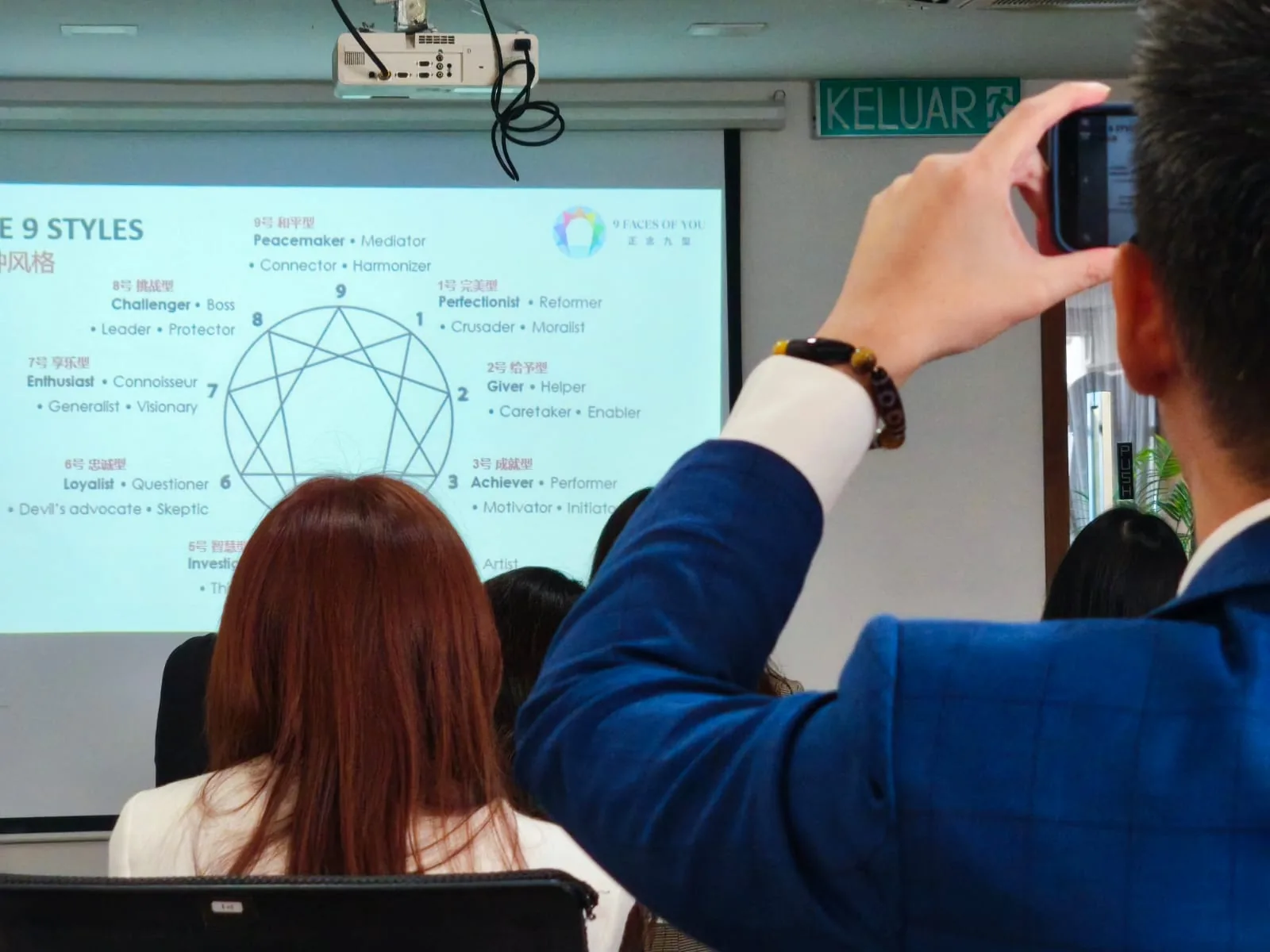
The founder and the successor almost always lead from different core motivations, and the handover goes wrong when each treats the other's pattern as a flaw. A founder who built the business over thirty years typically leads like an Enneagram Type 8 (decisive, protective, direct), a Type 3 (fast, results-driven, visible) or a Type 1 (exacting, principled, hard on sloppiness). The successor, educated abroad and brought up in the business's prosperity rather than its struggle, often works like a Type 9 (consensus, steady, conflict-avoiding), a Type 6 (careful, loyal, questions everything first) or a Type 5 (analytical, private, needs the data).
Put those two in a handover and the collisions are predictable:
| Moment | What the founder does | What the successor needs | What each concludes |
|---|---|---|---|
| A big decision | Decides in the car, announces at lunch | Wants the numbers, a night to think, and to be asked | "He is slow." / "He does not respect me." |
| Something goes wrong | Says it immediately, bluntly, often in front of staff | Needs it in private, with the reasoning | "She cannot take pressure." / "He thinks I am an idiot." |
| A long-serving manager underperforms | Protects him; loyalty is the point | Wants a process; fairness is the point | "She has no loyalty." / "He runs it like a kampung." |
| New ideas | "We tried that in 2009." | Has a deck and a consultant | "Theory." / "Stuck." |
None of those conclusions is true. They are two normal ways of leading, reading each other without a translator. The Enneagram is the most practical translator we know, because it names the pattern without naming a villain, which in a family is the only kind of naming that works. We map the founder and the successor on X-Map before a single line of the handover plan is written. Thirty minutes, both of them in the room, and for the first time the argument is about the pattern rather than about who is right.
Siblings, cousins and the non-family GM
The handover is rarely a pair; it is a small team, and the team needs the same honesty. The questions a family avoids are the ones the plan must answer in writing:
- Who leads, and who else has a real role? One CEO. Siblings in defined positions with their own numbers, or on the board with a clear mandate, not floating "directors" who can override anyone.
- What is the non-family GM's place after the handover? If he is going to run operations for the successor, say so, in writing, with the authority to match, before the successor arrives. If he is not, say that too, and plan his exit with dignity.
- How will the family disagree? A monthly family council with an agenda is unglamorous and it is the single structure that prevents the Sunday-lunch ambush.
Patrick Lencioni puts the absence of trust at the base of every team dysfunction. In a family business the trust is usually there; what is missing is the permission to disagree out loud. That permission has to be granted by the founder, in front of everyone, and then honoured the first time someone uses it.
A twelve-month handover that actually transfers authority
A handover works when the successor gets real authority over one whole area early, the founder visibly stays out of it, and the scope widens on a calendar everyone can see. A workable year looks like this:
- Months 1–2: map before you move. Founder, successor, siblings in roles, and the top five managers each take the Enneagram assessment. Read the key pairs. Write down, in plain words, how each person decides, gives feedback and behaves under pressure. Most families have never done this and it changes the tone of everything that follows.
- Month 2: the founder's new job. Chairman, biggest customers, the next expansion, the industry association. Something real, with a diary. A founder with nothing to do will manage the successor instead.
- Months 3–6: one whole area. The successor runs, say, sales and marketing end to end, including hiring and firing. The founder does not attend those meetings. The managers are told this directly by the founder, not by the successor.
- Months 6–9: the second area and the first hard decision. Usually a people decision: a long-serving manager, a family member who is not performing, a supplier who is a friend. The successor makes it. The founder backs it in public, whatever he says in private.
- Months 9–12: the money. Bank relationships, signing authority, the board. Only now the shareholding, because by now it is describing something that already exists.
Illustrative composite: a second-generation successor at a manufacturing group in Johor had held the managing director title for two years. Every decision above RM 50,000 still went to her father. The managers had learnt to ask him first. When we mapped the pair, the pattern was a Type 8 founder who read his daughter's careful questions as weakness, and a Type 6 successor who read his speed as recklessness and had stopped bringing him anything until it was perfect, which made her look slow. The fix was a signing limit that moved up every quarter, a weekly thirty-minute meeting where she brought the unfinished decisions, and a rule that corrections happened in that room and nowhere else. Eighteen months later he spends his mornings on the golf course and his afternoons on a joint venture in Vietnam. The managers ask her first.
Preparing the successor, and who pays for it
A successor needs leadership development that is about self-awareness and reading people, because that is what the role demands and what a technical education does not supply. The founder learnt it by surviving thirty years of mistakes. The successor does not have thirty years. Three things shorten the road:
- Business Enneagram Leadership, our two-day programme in Kuala Lumpur, in English or Mandarin, where the successor finds their own pattern first and then learns to read the founder, the siblings and the managers they are about to lead. Many successors attend with a sibling or with the non-family GM.
- A team read of the leadership team, so the successor inherits a map of the relationships, not only an org chart.
- Advisor sessions through the first year, with someone who has been the CEO reporting to owners and the manager caught between generations.
On cost: when the successor is a Malaysian employee on the payroll of a company registered with HRD Corp (what most people still call HRDF), the programme is claimable under SBL-Khas with nothing to pay upfront; we prepare the claim pack and claim directly. The founder can sit in the same room. Our step-by-step guide to claiming HRD Corp covers the timing. For Chinese, Taiwanese and Hong Kong family groups with a Malaysian subsidiary, see also our guide to building and leading a Malaysian team.
Why we are the right people to ask
Simyee Lim was the Group CEO of a Malaysian listed manufacturer, reporting to its owners, after seventeen years at Mercedes-Benz in Beijing in a company run largely in Chinese. Daniel Yeo has led teams and programmes across Malaysia, Singapore, China and Taiwan for more than two decades. Between us we have been the professional CEO the family brought in, the manager caught between a founder and a successor, and the advisor in the room when the family finally said the thing. We work in English and Mandarin, which in a Malaysian family business is often the difference between the founder joining the conversation and sitting outside it.
If you are a founder thinking about the next five years, or a successor who has the title and not yet the authority, the quickest start is a conversation about your family and your managers, in whichever language is easier. We will tell you plainly whether this fits.
Frequently asked questions
When should a family business in Malaysia start succession planning?
At least five years before the founder intends to step back, and in practice the day the successor joins the business. The first year of a handover should be spent on the relationships and the operating rhythm, not on the shareholding, because the shareholding only matters if the people can work together.
Should the successor be the eldest child?
Not automatically. The question is who can lead the business as it will be in ten years, and who the key managers will follow. Many Malaysian families do best with one family member as CEO, siblings in defined roles or on the board, and a strong non-family GM running operations. What matters is that the decision is made deliberately and explained, not assumed.
What if the founder cannot let go?
This is the most common failure, and it is rarely about trust in the successor; it is about identity. The practical fix is to give the founder a defined role with real work (chairman, major customers, the next big project) and a date, and to give the successor one whole area where the founder visibly does not interfere. Make both public to the management team.
How does the Enneagram help with family business succession?
It gives the family a neutral language for the things they cannot say directly: that the founder decides in minutes and the successor needs the data; that the founder's blunt feedback lands as contempt; that the daughter who runs finance and the son who runs sales read each other as reckless and timid. Once the pattern is on paper it stops being a personal accusation and becomes something to manage. We map it with X-Map before the handover plan is written.
Can we claim HRD Corp (HRDF) for the successor's leadership training?
Yes, if the successor is a Malaysian employee on the payroll of a company registered with HRD Corp that contributes the levy. Business Enneagram Leadership and our in-house programmes are claimable under SBL-Khas with nothing to pay upfront. The founder can attend the same session; only Malaysian employees' seats are claimed.